
Ship Crew Management System
A comprehensive web-based crew management platform for the maritime industry, streamlining crew recruitment, documentation, and placement operations with 8+ automated document types (TWIMC letters, crew mutations, MCU referrals, placement agreements, invoices), role-based access control, document workflow tracking, and digital signature integration. Built with Laravel 9, featuring 31 Eloquent models, 19 controllers, 38 database migrations, and 115+ Blade templates.
The Challenge
In the maritime industry, managing ship crews isn't just about people—it's about paperwork. Lots of it. A maritime crew recruitment and placement company faced a familiar struggle: mountains of manual documentation, scattered Excel sheets, and a paper trail that made compliance tracking a nightmare.
Every crew member required dozens of official documents. Every ship placement demanded signed letters, medical clearances, and financial records. The administrative burden was slowing down operations and increasing the risk of errors.
The Solution
This system was born—a purpose-built crew management system designed specifically for the maritime industry's unique requirements. Rather than forcing a generic HR system to fit maritime workflows, I developed a specialized platform that speaks the language of shipping operations: sign-on letters, crew mutations, MCU referrals, and placement agreements.
Document-First Architecture
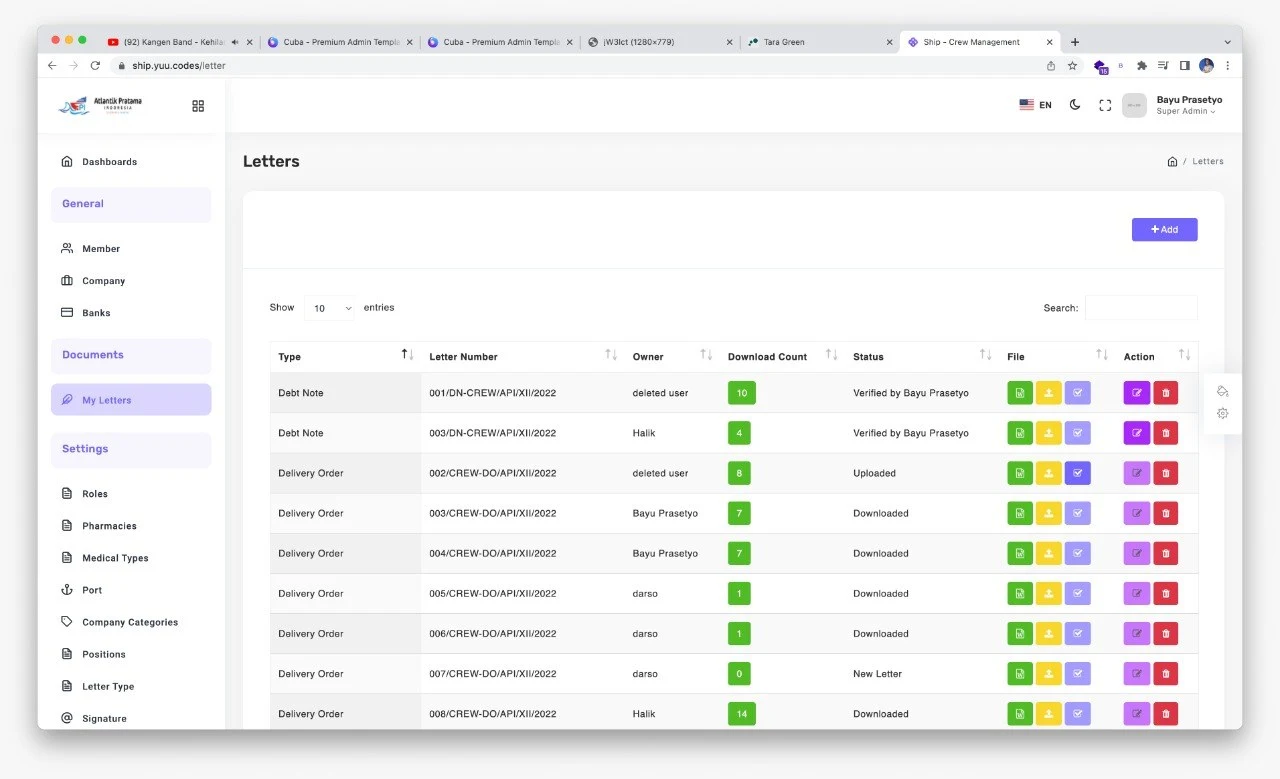
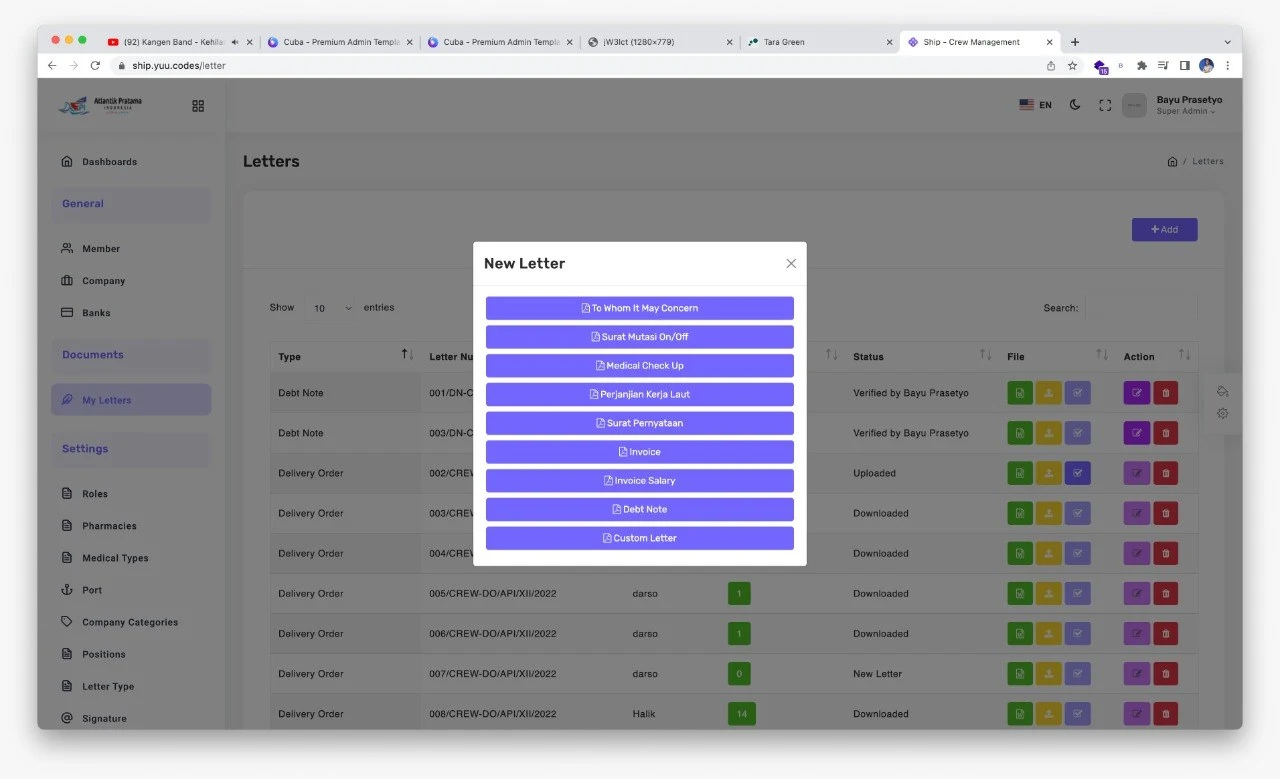
The system revolves around documents because that's what maritime operations revolve around. It generates 8+ official document types with automated numbering, proper formatting, and digital signature integration: To Whom It May Concern (TWIMC) Letters, Crew Mutation Records (Sign-on/Sign-off), Medical Check-Up (MCU) Referrals, Placement Agreements (PKL), Company & Salary Invoices, Debt Notes, Official Statements, and Delivery Orders.
Complete Crew Lifecycle Management
From initial recruitment to final sign-off, the system tracks every aspect of a seafarer's journey: Personal details with passport and seafarer documentation, position assignments and employment history, company placements with start/end dates, wages and overtime tracking, and medical compliance records.
Smart Access Control
Not everyone needs access to everything. The granular permission system ensures admins manage master data and system configuration, operations staff handle day-to-day crew documentation, each user sees only what they need to see, and audit trails track who did what and when.
Technical Implementation
I chose Laravel 9 as the foundation for several reasons: Eloquent ORM handles the complex relationships between crews, companies, documents, and positions elegantly. Blade templating enables rapid UI development with the Cuba admin theme. Built-in authentication provides secure, session-based access out of the box. Migration system keeps the database schema versioned and deployable.
The database schema centers around a polymorphic letter system—one letters table connects to 8+ specific letter type tables, enabling consistent tracking while maintaining type-specific fields. This design allows new document types to be added without disrupting existing functionality.
Scale of Implementation
31 Eloquent Models representing the business domain
19 Controllers handling all CRUD and business logic
38 Database Migrations defining the schema evolution
115+ Blade Templates for the user interface
1,300+ lines in the LetterController alone for document management
The Impact
This system transformed how maritime companies handle crew operations: Faster Document Generation—letters that took hours now take minutes. Centralized Records—no more scattered spreadsheets. Compliance Ready—complete audit trails for inspections. Reduced Errors—automated numbering eliminates duplicates. Better Visibility—track any crew member's status instantly.
Lessons Learned
Building for the maritime industry taught me several valuable lessons: Domain knowledge matters—understanding maritime terminology and workflows was crucial. Documents are first-class citizens—in compliance-heavy industries, the document isn't just output, it's the product. Flexibility within structure—the polymorphic letter design proved invaluable for adding new document types without refactoring core functionality.